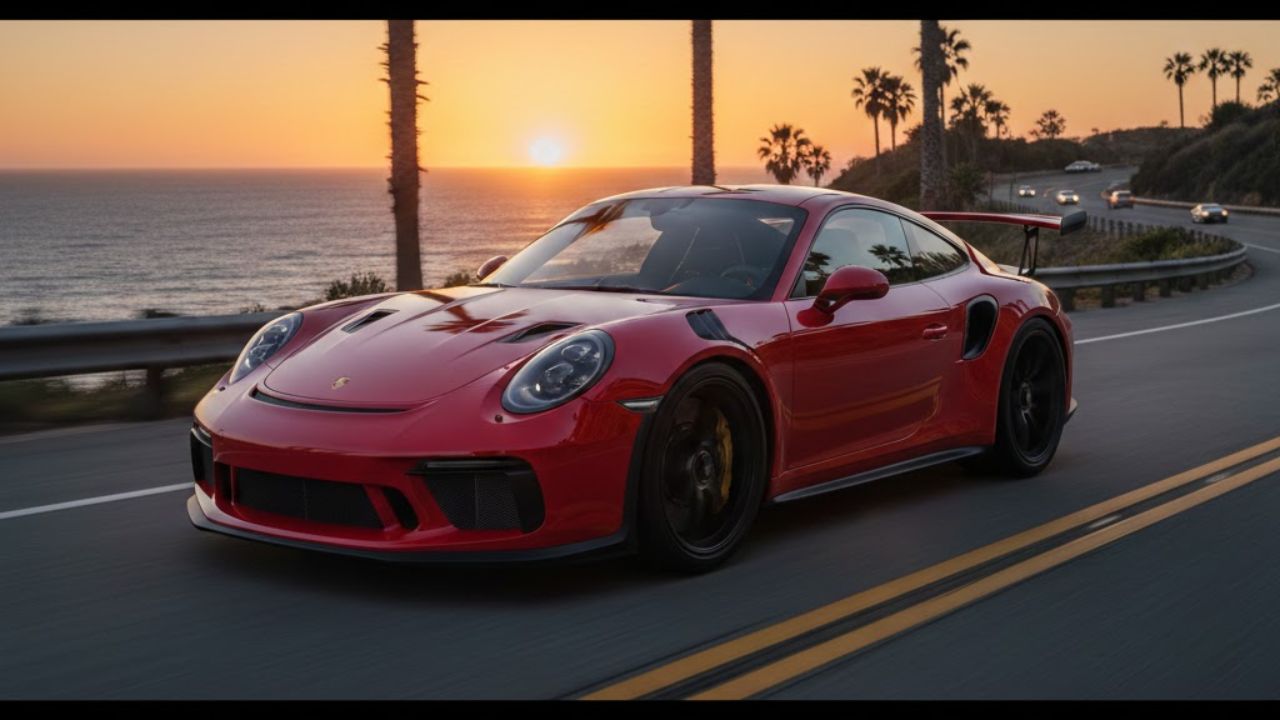
For decades, the Porsche 911 has remained the gold standard for sports cars, managing to evolve with modern technology while stubbornly clinging to its iconic rear-engine silhouette. As we move into 2026, the 911 lineup has undergone its most significant transformation yet with the “992.2” mid-cycle refresh. This update is not just a facelift; it marks the dawn of electrification for the flagship GTS models and a substantial power boost across the board. Whether you are a purist seeking a manual gearbox or a tech enthusiast looking for hybrid performance, the current 911 family offers a diverse range of machines designed to dominate both the Nürburgring and the daily commute.
The New 992.2 Era: Design and Aerodynamics
The latest iteration of the 911 features a more aggressive exterior that prioritizes airflow and cooling. At the front, the 992.2 Carrera and GTS models sport new bumpers with active vertical cooling flaps that open and close based on the car’s thermal needs. Porsche has also integrated all light functions—including the indicators—into the standard Matrix LED headlights, allowing for larger front air intakes. The rear end is equally modernized, featuring a redesigned light bar with integrated “PORSCHE” lettering and a new exhaust grille that improves heat dissipation for the more powerful engines.
Performance and the T-Hybrid Powertrain
The biggest headline for the 2026 model year is the introduction of the T-Hybrid system in the Carrera GTS. This innovative powertrain utilizes a newly developed 3.6-liter flat-six engine paired with an electric exhaust gas turbocharger and a permanent-magnet synchronous motor integrated into the eight-speed PDK transmission. This system provides a combined output of 532 horsepower and 449 lb-ft of torque, enabling a blisteringly fast 0-60 mph time of just 2.9 seconds. Even the entry-level Carrera has received an upgrade, now producing 388 horsepower thanks to turbochargers borrowed from the previous GTS model.
| Model Variant | Horsepower | 0-60 MPH (Sec) | Top Speed (MPH) | Starting Price (MSRP) |
| 911 Carrera | 388 hp | 3.9 s | 183 mph | $132,300 |
| 911 Carrera S | 473 hp | 3.3 s | 191 mph | $151,700 |
| 911 Carrera GTS | 532 hp | 2.9 s | 194 mph | $175,900 |
| 911 Turbo S | 711 hp | 2.4 s | 200 mph | $270,300 |
| 911 GT3 | 510 hp | 3.2 s | 193 mph | $222,500 |
Interior Innovation and Digital Evolution
Inside the cabin, the 2026 Porsche 911 bridges the gap between classic ergonomics and futuristic tech. For the first time in the model’s history, the 911 features a fully digital 12.6-inch curved instrument cluster, replacing the traditional analog tachometer. While some purists may miss the physical needle, the new display offers up to seven different views, including a “Classic” layout that pays homage to the five-dial design of the 1960s. The center console retains its 10.9-inch touchscreen with improved Apple CarPlay integration, while a new starter button replaces the historic twist-key ignition on the left side of the steering wheel.
Handling, Braking, and Ride Quality
Porsche continues to refine the 911’s handling through advanced chassis systems. The 2026 GTS models now come standard with rear-axle steering, significantly improving agility at high speeds and maneuverability in tight corners. The Porsche Active Suspension Management (PASM) has been recalibrated to offer a wider spread between comfort and performance, allowing the car to feel supple on rough roads while remaining flat during track sessions. Braking performance remains industry-leading, with the Carrera S and GTS utilizing larger discs, while the Turbo S comes standard with Porsche Ceramic Composite Brakes (PCCB).
The 2026 Buying Guide and Pricing
Ownership of a 911 remains a premium experience, with prices reflecting the car’s advanced engineering. The lineup begins with the Carrera at $132,300, but the “sweet spot” for many enthusiasts remains the Carrera S, which offers a perfect balance of daily usability and track-ready power for roughly $151,700. For those who demand the pinnacle of internal combustion and electric synergy, the GTS and Turbo S models sit at the top of the hierarchy, often reaching well over $300,000 once highly customizable options like paint-to-sample (PTS) and specialized interior leathers are added.
Summary: A Legacy Continued
Ultimately, the 2026 Porsche 911 proves that hybridization does not have to come at the expense of soul. By focusing on “Performance Hybrid” technology rather than just fuel efficiency, Porsche has made the 911 faster and more responsive than its predecessors. The 992.2 generation successfully navigates strict global emissions standards while retaining the visceral flat-six scream and the surgical precision that has defined the brand for over sixty years. It remains a masterpiece of German engineering, standing tall as the world’s most versatile and capable everyday supercar.
FAQs
Q1 Does the 2026 Porsche 911 still offer a manual transmission?
Yes, Porsche continues to offer a 6-speed or 7-speed manual transmission on specific enthusiast-focused models like the Carrera T and the GT3, though the high-performance GTS and Turbo models are exclusively PDK.
Q2 What is the “T-Hybrid” system in the new 911 GTS?
The T-Hybrid is a performance-oriented hybrid system that uses a small electric motor to spin the turbocharger instantly, eliminating lag, and another motor in the gearbox to provide an immediate torque boost.
Q3 Is the new 911 a 2-seater or a 4-seater?
Most 911 models are sold as 2+2 seaters, featuring small rear seats suitable for children or luggage. However, some lightweight versions like the GT3 or Carrera T can be configured as pure 2-seaters to save weight.
Disclaimer:
The content is intended for informational purposes only. You can check the official sources; our aim is to provide accurate information to all users.